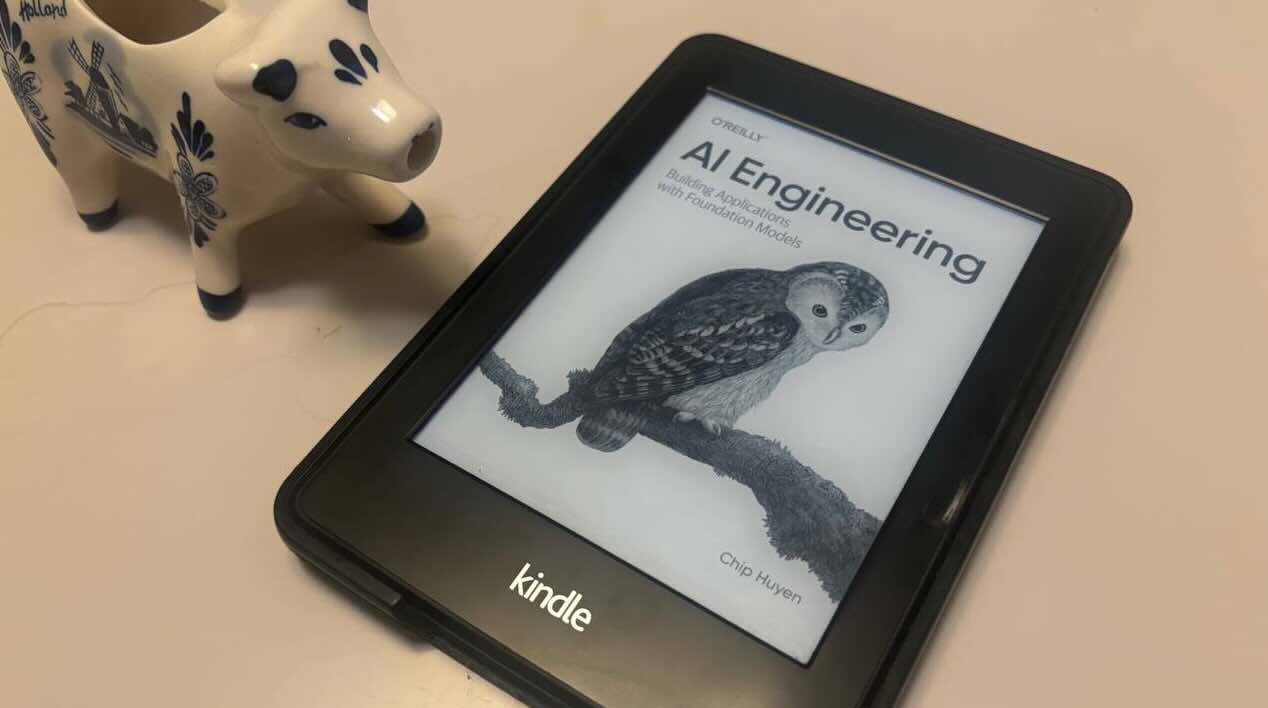
I finished reading the “AI Engineering” book by Chip Huyen some time ago and it was quite a long read for a technical book. I’m interested in AI technology and this book received quite a lot of hype which meant I had to read it.
Expectations & Reality
At the beginning, I was a bit skeptical of the idea of a book about AI engineering now - an area that evolves very rapidly and which appeared just a few years ago (referring not to AI engineering in a general sense, but to the surge of interest following the release of ChatGPT). I expect that many things that are considered standard and best practices today may change a lot in the near future and that would make the book obsolete fast. But I was surprised by how Chip approached writing on this topic: the book seriously tries to talk about fundamentals of the technology and it often talks about how certain aspects of it should be reasoned about instead of providing step-by-step guidance. Maybe not everything in this book is like this: some model architectures or concepts like “LLM as a judge” might disappear in the future. But overall, the book has the potential of remaining relevant.
The book is technical but not at the level of scientific papers or industry manuals. It felt similar to reading encyclopedias as a kid - it covers all important areas of the domain, it shares scientific facts, it summarizes the subject well and makes the reading easier by giving you historical reference on the evolution of the technology and facts from research. But the book doesn’t go deep enough into the topics to make me use this information as a professional. For instance, when I finished reading “Designing Data-Intensive Applications” (it was quite some time ago), I felt like “huh, if I ever need to build pattern X mentioned here, I can definitely go back and re-read the chapter about it”. Here, I didn’t get that feeling.
Verdict
I found myself questioning the intended audience. For engineers and researchers, the content might feel too high-level. However, for managers and founders who need to grasp the “how” and “why” of the technology but don’t have hands-on experience this book is likely a better fit.
Overall, I’m glad that I read this book. I learned many new things, especially from chapters covering layers of the stack with which I had no prior experience: inference and finetuning. While it might not have been the most efficient deep-dive for me as an engineer, I found great value in the broader context it provides. I’ll certainly be keeping an eye on Chip Huyen’s future work, and I’m grateful to her for putting this book together.